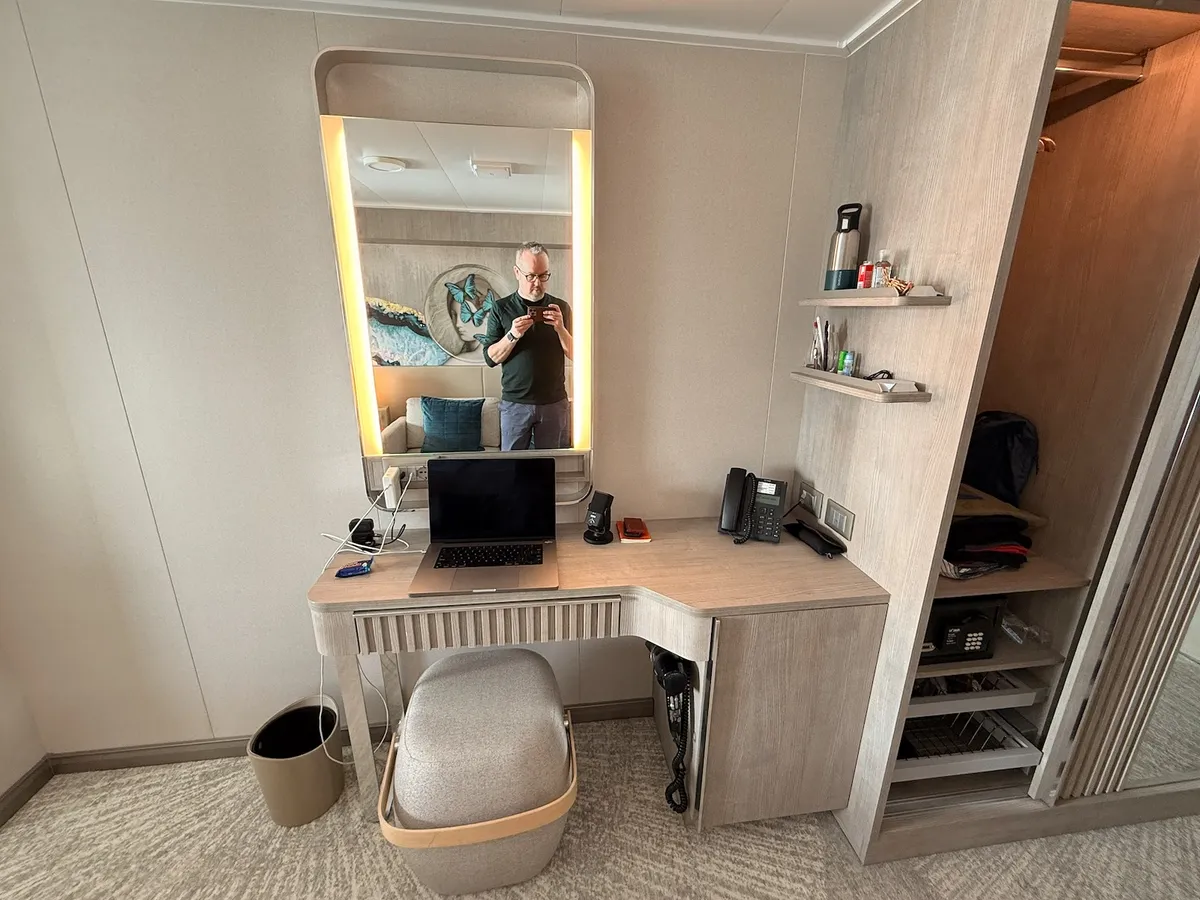
Norwegian Prima looks like a straightforward ship to book. The cabin categories are clearly labelled, the deck plan is well organised, and the standard cabins are larger than those on older NCL ships. But the deck plan does not tell you everything. It will not show you that the Prima Theatre converts to a nightclub after 10pm, that dry slides run past balcony windows, or that the go-kart racetrack on Deck 18 generates engine noise that carries down to Deck 15.
I sailed Norwegian Prima on a transatlantic repositioning in 2025 and learned quickly which parts of the ship to avoid. Not every problem zone is obvious, and some of them only emerge after dark.
How to Read This Guide
This guide covers four types of cabin problems: noise, obstructed views, high-traffic areas, and motion. Cabin numbers and deck references are based on the current deck plan as of early 2026. NCL does periodically refit ships and reassign cabin categories, so verify the deck plan at the time of booking. If a cabin number mentioned here no longer exists, the principle still applies - check what sits above, below, and beside your cabin before you commit.
Cabins Near Noise Sources
Theatre and Club
The Prima Theatre and Club sits on Deck 8 forward. It hosts evening shows and then converts into a nightclub with DJ sets that can run past midnight. Cabins on Deck 9 forward - roughly cabins 9100 through 9170 on the port side and 9700 through 9770 on the starboard side - sit directly above this venue.
The noise is not subtle. Multiple passengers report hearing bass beats and music through the floor, particularly after 10pm when the nightclub programme starts. If you are someone who goes to bed before midnight, these cabins will frustrate you. Even with the balcony door closed, the bass vibration can travel through the deck structure. This is the single most important cabin zone to avoid on Norwegian Prima.
Late-Night Venues
Beyond the theatre-nightclub, the Metropolitan Bar on Deck 7 and the Whiskey Bar on Deck 8 can generate corridor noise for cabins nearby. The bars themselves are not especially loud, but passengers leaving them late at night walk through residential corridors on Decks 7 and 8. Cabins near the lift lobbies on these decks get the worst of it.
The Local Bar and Grill on Deck 8 is open 24 hours. Cabins immediately adjacent to The Local’s entrance hear doors and foot traffic through the night. This is less of an issue than the theatre, but it is worth noting if you are comparing specific cabin numbers on Deck 8.
Pool Deck and Speedway
The pool deck sits on Deck 17. Cabins on Deck 16 directly below the pool area can hear morning setup activity - sun loungers being dragged into position, equipment being moved, and early risers arriving from around 6:30am.
More significantly, the Prima Speedway go-kart racetrack wraps around Decks 18 and 19. The electric karts generate a snarling engine noise that carries down to Decks 15 and 16 when balcony doors are open. One Frommer’s reviewer on Deck 15 described hearing the vehicles clearly from their balcony, four decks below the track. If you want to sit on your balcony in peace during the afternoon, avoid midship cabins on Decks 15 and 16.
Engine and Mechanical
Norwegian Prima uses azipod propulsion, which is quieter than the traditional shaft-driven systems on older NCL ships like Norwegian Star. The lowest passenger deck is Deck 5, and for most of the voyage it is acceptably quiet.
The exception is at ports. The side thrusters used for docking generate vibration that passengers on Deck 5 aft can feel. One passenger in cabin 5178 reported persistent bass noise from a crew recreation area directly beneath their Deck 5 cabin that lasted from 11:30pm to 1:30am nightly. NCL acknowledged the issue but could not resolve it during the voyage. This may be an isolated case, but Deck 5 aft remains a risk for light sleepers.
Cabins with Obstructed Views
Norwegian Prima has two types of view obstructions that catch passengers off guard.
The first is the dry slides. The Rush and The Drop are large slide structures that curl down the exterior of the ship, passing directly in front of several balcony cabins between Decks 9 and 16. NCL identifies some of these as category O2 - an obstructed balcony priced at ocean view rates. Specific cabins to watch for include 16190, 16192, 16790, 16792, 15196, 15198, 15796, and 15798. The obstruction varies by cabin. Some have a partial block from a slide support. Others have the slide tube itself passing across the balcony view.
The slides close in the evenings, so noise is mainly a daytime issue. But if you want to enjoy a quiet breakfast or afternoon coffee on your balcony, a slide passing your window with passengers screaming is not ideal. The discount NCL offers on these cabins is sometimes modest, and the trade-off is rarely worth it.
The second type is standard lifeboat obstructions. These are less of an issue on Norwegian Prima than on older ships. The lifeboats sit on Deck 8, below most balcony cabins. However, some ocean view cabins on Deck 5 have partial obstructions from structural elements. NCL marks these in the booking system, but the extent of the obstruction is hard to judge without seeing photos of the specific cabin.
If you want an obstructed-view cabin at a discount, the O2 category on Deck 11 is the better bet. These cabins have a partial slide or structural obstruction but still let in natural light and fresh air. If you are someone who mainly uses the balcony for air rather than views, and you want to save money, this can be a reasonable trade.
Cabins Near High-Traffic Areas
Cabins adjacent to lift lobbies on any deck will hear the ding of arriving lifts and the foot traffic of passengers heading to restaurants, the pool, or entertainment. On Norwegian Prima, the main lift lobbies are midship. Cabins immediately flanking the lobby - check the deck plan for the first cabin number on each side of the lift bank - get the most traffic noise.
Connecting cabins are a significant issue on this ship. The interconnecting doors between adjoining cabins are noticeably less soundproof than the standard cabin walls. Multiple reviewers report hearing conversations, children playing, and television audio through the connecting door even when it is locked. On the deck plan, connecting cabins are marked with a double-ended arrow between the cabin icons. If you are booking one cabin and do not need a connection, avoid any cabin with this marking.
The bathroom doors on Norwegian Prima also deserve mention. They have strong springs that slam shut if you release them. This is not a location issue - it affects every cabin on the ship. But it is a noise source within your own cabin. If you are sharing with a light sleeper, practise closing it gently on the first night.
Self-service laundry facilities are not available on Norwegian Prima, so that is one high-traffic concern you do not need to worry about. However, crew access doors are present on most decks, typically at the forward and aft ends of cabin corridors. Cabins near these doors may hear activity during shift changes, particularly early morning.
Cabins Affected by Motion
Norwegian Prima is a large ship at 142,500 gross tonnes, and it has stabilisers. On most itineraries, motion is not a significant issue. But on transatlantic crossings and rough-weather routes, the physics still apply.
Forward cabins on higher decks - Deck 15 and 16 forward - experience the most pitch and roll. I sailed a transatlantic on Prima and the forward cabins on upper decks had noticeably more movement during the rougher days of the crossing. Aft cabins on higher decks can sway in beam seas.
The least motion is at the ship’s centre of gravity: midship, lower-to-mid decks. Decks 9 through 12 midship are the most stable zones. If you are prone to seasickness, book here and avoid the forward cabins on Decks 14 and above.
The stabilisers on Prima are effective when deployed. NCL typically runs them on open-water segments. But in sheltered waters or port approaches, they may be retracted, and any residual motion will be felt most in the extremities of the ship - bow and stern, high up.
What to Book Instead
The safest zone on Norwegian Prima is Deck 11 midship, either port or starboard. Cabins 11100 through 11170 (port) and 11700 through 11770 (starboard) sit in a pure residential corridor with no public spaces above or below. You are three decks above the theatre, well below the pool deck, and away from The Haven’s aft elevators.
For a budget option within the safe zone, look at inside cabins on Deck 12 midship (category IA). These are 160 sq ft, compact but functional, and positioned away from the Studio Lounge and crew areas. They are among the cheapest cabins on the ship and you will sleep well.
For a splurge option, the Club Balcony Suite (category MA) on Deck 11 aft offers 265 to 291 sq ft with a 45 sq ft balcony. The aft position gives you a quieter corridor and partial wake views. It costs modestly more than a standard balcony and includes a small champagne welcome.
For a full breakdown of the best spots on this ship, including specific recommendations for solo travellers, families, and couples, see my guide to understanding cruise cabins.
Frequently Asked Questions
- What is the noisiest deck on Norwegian Prima?
- Deck 9 forward is the noisiest residential area on the ship. It sits directly above the Prima Theatre and Club, which converts to a nightclub after the evening shows. Passengers in cabins around 9100 through 9170 report hearing bass and music late into the night. Deck 16 midship can also be noisy due to the Speedway racetrack above.
- Are obstructed view cabins on Norwegian Prima worth booking?
- It depends on the obstruction. The slide-obstructed balconies (cabins near 15196, 15798, 16190, 16792) are a poor deal because the slides also bring noise and people sliding past during the day. The O2 obstructed balcony cabins on Decks 11 and 14, priced at ocean view rates, can be reasonable if you mainly want fresh air and do not mind a partial block.
- Are connecting cabins on Norwegian Prima noisy?
- The interconnecting doors between connecting cabins on Norwegian Prima are noticeably less soundproof than standard cabin walls. Multiple passengers report hearing conversations, children, and TV clearly through the connecting door, even when it is locked. If you only need one cabin, check the deck plan for the double-ended arrow symbol and avoid those cabin numbers.
- Is Deck 5 on Norwegian Prima a good choice?
- Deck 5 is a mixed bag. The cabin sizes are generous, especially the family ocean view cabins that reach 370 sq ft. But the deck sits above crew areas, and at least one passenger has reported persistent bass noise from a crew bar directly beneath their cabin (cabin 5178). If you are a light sleeper, Deck 5 aft is risky.